 Manufacturing Toolkit

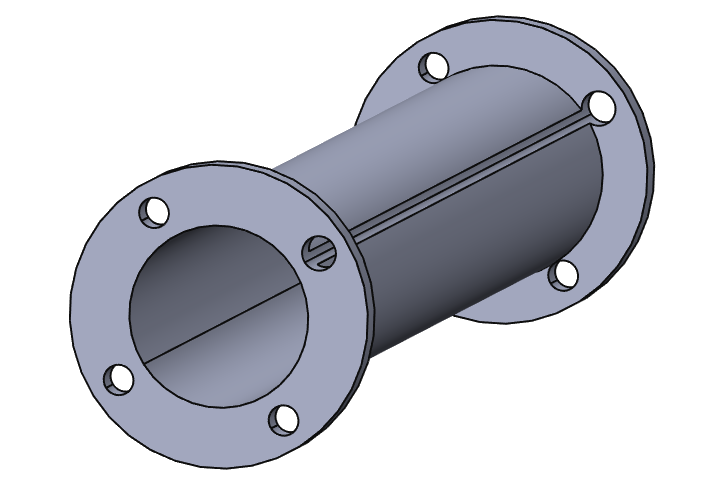
Wall thickness calculation algorithm allows analyzing wall thickness of the model and return information about minimum and maximum thicknesses.
As the API changes to accommodate the needs of users compatibility will be preserved as much as possible but is ultimately not guaranteed.
| The model | Wall thickness information |
|---|---|
|
|
Wall thickness tool (WallThickness_Analyzer) works with ModelData::Solid and ModelData::IndexedTriangleSet .
WallThickness_Analyzer is the class that performs wall thickness analysis of a given ModelData::Solid or ModelData::IndexedTriangleSet . It returns WallThickness_Data that contains a thickness field and additional information about minimum and maximum thicknesses. See Wall Thickness Analyzer Example.
Computationally demanding and robust wall thickness algorithm. The accuracy of wall thickness calculation depends on the given resolution value. The result values can be slightly inaccurate and the smaller thicknesses values (less than a voxel size) can be ommited due to voxel discretization. It should be at least 20, otherwise the algorithm will not produce any results. The larger the value, the higher the accuracy of the calculations. The recommended values are 100 - 5000. High values greatly increase computation time and memory usage.
Sensitive and fast wall thickness algorithm. Small memory footprint. Provides high performance with high-accuracy results for fine meshes. Vulnerable to inaccurate or corrupted meshes, yielding tiny min thickness values. Recognizes a wall as a pair of almost opposite triangles. The maximum angle between two sides for them to be counted as a wall is described by WallThickness_RayMarchingParameters::WallSidesAngleTolerance parameter. For example, if the value is greater than \( \frac{\pi}{2} \), then even perpendicular edges could be paired into a wall.