 Manufacturing Toolkit

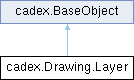
Provides logical grouping of Element objects. More...
Public Member Functions | |
| Layer (global::System.IntPtr cPtr, bool cMemoryOwn) | |
| Layer () | |
| Constructor. | |
| Layer (cadex.UTF16String theName) | |
| Creates a named object, if theName is not empty. | |
| void | SetName (cadex.UTF16String theName) |
| Sets a layer name. | |
| cadex.UTF16String | Name () |
| Returns a layer name. | |
| void | SetUuid (System.Guid theUuid) |
| System.Guid | Uuid () |
| bool | IsVisible () |
| Returns false if the drawing layer IsNull(). | |
| void | SetIsVisible (bool theIsVisible) |
| Sets Layer visibility status. | |
| void | Add (cadex.Drawing.Element theElement) |
| Adds element to the drawing layer. | |
| bool | Remove (cadex.Drawing.Element theElement) |
| Returns true if the element has been in the list and false otherwise. | |
| bool | Contains (cadex.Drawing.Element theElement) |
| Returns true if element has already been added to the drawing layer. | |
| void | Accept (cadex.Drawing.ElementVisitor theVisitor) |
| Calls overloaded operator() of theVisitor for each element in drawing layer. | |
 Public Member Functions inherited from cadex.BaseObject Public Member Functions inherited from cadex.BaseObject | |
| BaseObject (global::System.IntPtr cPtr, bool cMemoryOwn) | |
| void | Dispose () |
| bool | IsNull () |
| ulong | Id () |
| Return unique identifier of public object. | |
| bool | IsEqual (cadex.BaseObject theObj) |
| override int | GetHashCode () |
| override bool | Equals (System.Object o) |
Static Public Member Functions | |
| static bool | CompareType (cadex.BaseObject theObject) |
| static cadex.Drawing.Layer | Cast (cadex.BaseObject theBase) |
Protected Member Functions | |
| override void | Dispose (bool disposing) |
Provides logical grouping of Element objects.
Layers are commonly used to group objects in the drawing by function (e.g. walls, furniture, etc.), but in principle they can represent any type of virtual grouping. All objects in a layer share appearance, can be shown and hidden together. A drawing element can only belong to one layer.
The drawing layer holds an IsVisible() attribute, which is true by default.
|
inline |
Constructor.
Creates not initialized object, for which IsNull() returns true.
|
inline |
Creates a named object, if theName is not empty.
Constructor.
|
inline |
Calls overloaded operator() of theVisitor for each element in drawing layer.
Accepts the element visitor.
|
inline |
Adds element to the drawing layer.
|
inline |
Returns true if element has already been added to the drawing layer.
|
inlineprotectedvirtual |
Reimplemented from cadex.BaseObject.
|
inline |
Returns false if the drawing layer IsNull().
Returns true if the drawing layer is visible.
|
inline |
Returns a layer name.
|
inline |
Returns true if the element has been in the list and false otherwise.
Removes element from the drawing layer.
|
inline |
Sets Layer visibility status.
|
inline |
Sets a layer name.