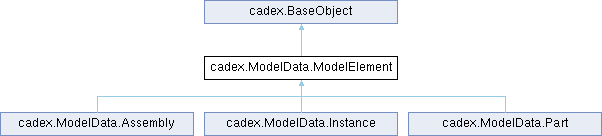
Base class for part, instance and assembly.
More...
|
|
| ModelElement (global::System.IntPtr cPtr, bool cMemoryOwn) |
| |
| void | SetName (cadex.UTF16String theName) |
| | Accepts a string as a unicode string.
|
| |
| cadex.UTF16String | Name () |
| | Returns empty string if the model element has no name (by default).
|
| |
| void | SetUuid (System.Guid theUuid) |
| | Sets an object uuid.
|
| |
| System.Guid | Uuid () |
| | Returns an object uuid.
|
| |
| void | SetPMI (cadex.PMI.Data thePMI) |
| | Sets the object PMI.
|
| |
| cadex.PMI.Data | PMI () |
| | Returns the object PMI.
|
| |
| void | Accept (cadex.ModelData.ModelElementVisitor theVisitor) |
| | The order of visiting depends on the type of this object:
|
| |
|
| BaseObject (global::System.IntPtr cPtr, bool cMemoryOwn) |
| |
|
void | Dispose () |
| |
|
bool | IsNull () |
| |
| ulong | Id () |
| | Return unique identifier of public object.
|
| |
|
bool | IsEqual (cadex.BaseObject theObj) |
| |
|
override int | GetHashCode () |
| |
|
override bool | Equals (System.Object o) |
| |
|
| override void | Dispose (bool disposing) |
| |
◆ Accept()
| void cadex.ModelData.ModelElement.Accept |
( |
cadex.ModelData.ModelElementVisitor | theVisitor | ) |
|
|
inline |
The order of visiting depends on the type of this object:
- for a part invokes a visitor for the part (ModelData.ModelElementVisitor.operator());
- for an instance first enters the instance by calling ModelData.ModelElementVisitor.VisitEnter()). If it returns true then visits the referred element. Then leaves the instance calling ModelData.ModelElementVisitor.VisitLeave().
- for an assembly first enters the assembly by calling ModelData.ModelElementVisitor.VisitEnter()). If it returns true then visits all the assembly children. Then leaves the assembly calling ModelData.ModelElementVisitor.VisitLeave(). Accepts an element visitor.
◆ CompareType()
| static bool cadex.ModelData.ModelElement.CompareType |
( |
cadex.BaseObject | theObject | ) |
|
|
inlinestatic |
Returns true if theObject is a model element.
◆ Dispose()
| override void cadex.ModelData.ModelElement.Dispose |
( |
bool | disposing | ) |
|
|
inlineprotectedvirtual |
◆ Name()
Returns empty string if the model element has no name (by default).
- See also
- SetName(). Returns a name.
- Examples
- MTKConverter/Program.cs, MTKConverter/main.cxx, exploring/bom/Program.cs, exploring/bom/main.cxx, exploring/brep_geometry/Program.cs, exploring/brep_geometry/main.cxx, exploring/brep_topology/Program.cs, exploring/brep_topology/main.cxx, exploring/mesh/main.cxx, exploring/pmi/Program.cs, exploring/pmi/main.cxx, helpers/shape_processor.cs, helpers/shape_processor.hxx, machining/dfm_analyzer/Program.cs, machining/dfm_analyzer/main.cxx, machining/feature_recognizer/Program.cs, machining/feature_recognizer/main.cxx, molding/dfm_analyzer/Program.cs, molding/dfm_analyzer/main.cxx, molding/feature_recognizer/Program.cs, molding/feature_recognizer/main.cxx, projector/poly_projector/Program.cs, projector/poly_projector/main.cxx, sheet_metal/dfm_analyzer/Program.cs, sheet_metal/dfm_analyzer/main.cxx, sheet_metal/feature_recognizer/Program.cs, sheet_metal/feature_recognizer/main.cxx, sheet_metal/unfolder/Program.cs, and sheet_metal/unfolder/main.cxx.
◆ PMI()
| cadex.PMI.Data cadex.ModelData.ModelElement.PMI |
( |
| ) |
|
|
inline |
◆ SetName()
Accepts a string as a unicode string.
- See also
- Name(). Sets a name.
◆ SetPMI()
| void cadex.ModelData.ModelElement.SetPMI |
( |
cadex.PMI.Data | thePMI | ) |
|
|
inline |
◆ SetUuid()
| void cadex.ModelData.ModelElement.SetUuid |
( |
System.Guid | theUuid | ) |
|
|
inline |
◆ Uuid()
| System.Guid cadex.ModelData.ModelElement.Uuid |
( |
| ) |
|
|
inline |
 Manufacturing Toolkit

 Public Member Functions inherited from cadex.BaseObject